|
By John Hamer, Director of Outreach and Innovative Mission
In the final sessions of the 2025 World Conference, Community of Christ President Stassi Cramm made an exciting announcement: the church would resume hosting International Peace Forums triennially, beginning October 16–19, 2026. The Community of Christ Temple is dedicated to the promotion of world peace, and the Peace Forum has been at the heart of embodying that mission. The Peace Forum is a three-day event that includes addresses, panels, discussion sessions, workshops, hands-on activities, and the presentation of the church’s International Peace Award. The world is in critical need of peace—perhaps this year more than ever. Unfortunately, policies of the United States government have made travel to Independence, Missouri, impossible for some international visitors and have left others questioning whether this is a good time to cross international borders. For this reason, the Council of Twelve Apostles asked Community of Christ in Canada to host two remote locations for the Peace Forum: one in the greater Toronto area and one in Vancouver. The Canadian remote locations will participate with activities in Independence in much the same way that Canada hosted a remote location for the 2025 World Conference. For this year’s Peace Forum, the opening address, awards ceremony, plenary, and keynote speakers will all be livestreamed, and workshops will connect Toronto and Vancouver to Independence via videoconferencing. However, the Canadian sites will not just be places where we are watching something remotely. The Toronto and Vancouver sites will each include local speakers, workshops, and hands-on events in their own right. This will be a chance to meet visionaries and activists from around the world who are unable to travel to the United States to share. It will also give Canadians who are passionate about making the world a better place the opportunity to connect, get updated on current issues, and share strategies to effectively pursue peace. In addition, we want the Peace Forum to serve as an entry point for younger people in our extended church network. Community of Christ in Canada will be inviting youth and young adults participating in the conference to form focus groups to discuss what a peace church should look like. How can we be relevant to people who care about our planet and our place in it? We will also invite seekers who are not members of the church to share in the events. Although we will not be coming together in person this year for our annual Mission Centre Conference (the business meeting will be held online so that everyone across Canada can attend), the Peace Forum will provide a similar venue for sharing fellowship. We hope you’ll choose to find that fellowship by being part of the Peace Forum right here in Canada from Friday, October 16—Sunday, October 18. Save the date and stay tuned for more details as they become available.
0 Comments
By John Hamer, Director of Outreach and Innovation
“Now the Green Blade Rises” is probably my favourite hymn in Community of Christ Sings (#482). Beginning its life as a 15th-century French Christmas carol (Noël Nouvelet), the tune was given new lyrics in the early 20th century by Anglican canon J. M. C. Crum, who transformed it into a celebration of Easter. The lyrics connect the sacred story of Christ’s resurrection to the annual cycle of the seasons, and to the renewal of plant life we experience each year at Easter with the coming of spring: Forth he came at Easter, like the risen grain, he that for three days in the grave had lain; raised from the dead, my living Lord is seen; Love is come again like wheat arising green. The analogy of the life cycle of plants to Christ’s resurrection goes back to the very beginning of our tradition. The Apostle Paul writes: “What you sow does not come to life unless it dies. And as for what you sow, you do not sow the body that is to be but a bare seed, perhaps of wheat or of some other grain… So it is with the resurrection of the dead... The body that is sown is perishable; it is raised imperishable… it is sown a natural body, it is raised a spiritual body” (1 Corinthians 15:36–37, 42, 44). The idea of resurrection and Easter, then, involves a complete transformation: a spiritual rebirth that follows the death of the material. In our daily lives, we easily get caught up in the material concerns of the present. The chaos of current global events alone has reduced the timeframe of the 24-hour news cycle to the perpetual, instantaneous cycle of social media on our phones. A hymn like “Now the Green Blade Rises,” and words like Paul’s, help me to step back and connect to something larger: the annual cycle of life. And once we step back to contemplate and celebrate spring, we are on the path to step further back to consider ever larger cycles, like the human generational cycle we all experience. As we live our lives within the church, we are connected to a cycle that is still larger: the life of our congregations and the church itself. Many of our congregations in Canada are more than a century old, making us heirs to something much larger than ourselves. Nevertheless, even if they are much longer than the human life cycle, congregations have life cycles of their own. As trends have shifted in North America over the past half century, most of us have been experiencing life in congregations closer to the end of their cycle than the beginning. We are hardly alone; most of Canada’s churches are experiencing significant declines in membership. Some of us have begun to wonder if younger generations will even be interested in “church” in the future. I have actively focused on this question for decades, and for the last ten years outreach and invitation have been my life’s focus. At the beginning, we resolved to operate entirely outside the box. If Canada’s next, diverse generation was uninterested in “church,” perhaps we could translate our mission and our enduring principles into forms that would better resonate. From this period of experimentation, we learned much about effective ways to invite new people into community. Along the way, we also discovered something we did not expect: many young people are, in fact, quite interested in our sacred inheritance as Christians when we approach our distinctives in ways that are authentic and open. We learned this lesson through our Tuesday night lecture ministries, which began ten years ago as an outreach experiment. We started with a wide net, sharing across a broad range of topics in history, theology, and philosophy. Over time, we discovered that the most popular topics ended up being about Christianity: Bible study, Christian history, and theological questions. Last week, our Centre Place YouTube channel crossed a milestone of over 90,000 subscribers—an unprecedented number. As that community has grown, large numbers of seekers have been drawn to the non-dogmatic, inclusive, and authentic way we express Christianity in Community of Christ. Each week, as more people become regular participants in Beyond the Walls services, a sense of identity with our sacred community grows, leading now to requests for formal membership. When we began to plant seeds a decade ago, we had no conception of the crop that would arise. The many new expressions the church will take in the future have not yet fully taken form. But as someone who cares deeply for the body—its roots, heritage, and legacy—I am heartened. We are now experiencing the first fruits of a season of renewal. Remember, then, as the hymn assures us: When our hearts are wint’ry, grieving, or in pain, your touch can call us back to life again, fields of our hearts that dead and bare have been; Love is come again like wheat arising green. By Lanette Vawter, Director of Leadership Development
Recently, I read through the All Voices testimonies gathered from Community of Christ members across Canada in 2021. These testimonies revealed how faith and community are essential for nurturing hope and progress in the church, and I felt heartened and hopeful about our future. Over and over again, I read testimonies from people both young and old who spoke of the deep meaning and value of being in community with both God and others. I was touched by the faithfulness expressed in times of challenge and the hope for the future. In one testimony that deeply resonated with me, Doug Middleton says, “I am overjoyed at being a part of a progressive church, not a stagnant church—a church that works toward the fairness and equality of all people.” One of my mother’s favourite scriptures is Ecclesiastes 3:1: “For everything there is a season, and a time for every matter under heaven.” It reminds me that while seasons change, our response to God’s call for goodness and mercy continues to be possible. Our faithfulness and hope are so needed in our weary world. By Leandro Palacios, Director of Communications
The Communications Team is pleased to introduce the Email Preference Centre, a new tool that will give you more control over the emails you receive from Community of Christ in Canada. Why is this important? Our traditional newsletters—the Weekly Wire for Canada West and the What’s Happening for Canada East—were effective at keeping people informed in the past about news and events happening in the former mission centres. Moving onward together across Canada has expanded our perspective, but at the same time has created a communication challenge. On the one hand, we want to ensure people stay in the know, but on the other hand, we don’t want to overwhelm our audience with irrelevant content. For example, people in Vancouver may not be thrilled to receive invitations to in-person events in Ontario every week. When emails are no longer effective at keeping subscribers engaged, people unsubscribe or simply ignore them, which causes mail servers to flag messages as promotional content or even spam. Last year, as we envisioned how we would bring together all congregations and members across Canada within a single structure, the Mission Centre Design Team recognized the need to offer a way to customize the content people would receive in their inbox. The Email Preference Centre is our first step toward keeping emails relevant according to subscriber preferences—keeping people engaged, improving open rates, and helping messages reach inboxes consistently. This approach will also help us kickstart a campaign to grow our list of subscribers, because people are more likely to subscribe and stay engaged when they can choose what they want to receive. This keeps communication focused and meaningful, while still ensuring that everyone receives important updates that are relevant across Canada. In this first stage, we are introducing targeted communication based on interests, starting with camping and campground updates. With six campgrounds across Canada, this means people can choose to receive updates only from the communities they are part of, instead of all camp-related news. In the next stage, we will add options for geographic regions and other areas of interest. You can access the Email Preference Centre by clicking “update your preferences” at the bottom of any of our emails. You can also enter your email address and select your preferences using this form. If your email is already in our system, your preferences will be updated. Make sure you select all the newsletters you would like to receive in your inbox, as well as the campgrounds you would like to receive news and updates from. Let us know if you have any questions or additional ideas for keeping the conversation relevant and engaging as we continue moving onward together across Canada. Presiding Bishopric shares financial update The Presiding Bishopric recently hosted a Zoom session titled “A Future of Challenge and Hope: Community of Christ Financial Update.” During the 60-minute gathering, leaders shared updates on Worldwide Mission Tithes, endowments, the 2026 Worldwide Mission Budget, Graceland University, and strategic priorities guiding the church toward 2030. The session also highlighted how generosity continues to support digital ministry resources and long-term sustainability for mission. Emerge: An online meetup for youth ages 14-18—Mar 29 Be part of something special—Emerge is an online space where youth ages 14–18 can meet new friends, share experiences, and grow together in community. Everyone is welcome, and we’d love to see you there! 🗓️ Sunday, March 29 🕕 7pm ET/ 6pm CT/ 5pm MT/ 4pm PT Find your community: Young Adult Sundays Beginning March 2026, Young Adult Ministries (YAM) will host weekly Sunday gatherings via Zoom at 7:00 p.m. ET / 6:00 p.m. CT / 5:00 p.m. MT / 4:00 p.m. PT. These rotating online experiences offer young adults space for spiritual exploration and community. Each week focuses on a different theme, including devotional practices, Disarming Scripture, music and spirituality, creative expression, and Sabbath rest. For more information: contact Mikki Phillippe. Spiritual practice resources for Lent and Easter now available Community of Christ has released guided spiritual practice videos for Lent and Easter. These resources invite individuals, small groups, and congregations into reflection, prayer, and renewal as we journey toward Easter. The Lenten practice creates space to pause, listen, and open our hearts to God’s transforming presence during this sacred season. The Easter practice offers a quiet and personal encounter with the resurrection story through guided reflection and prayer. Both videos are designed to support communities seeking renewal, hope, and peace throughout the season. By Vonda DenBoer,Director of Camping and Campground Sustainability
Over the past year, I had the opportunity to meet people in camps across Canada. Each camp setting and camping experience is unique, yet the overarching vision of restoring persons to healthy or righteous relationship with God, others, themselves, and the earth (Doctrine and Covenants 163:2b) is at the heart of every camp experience. Perhaps this shared purpose is part of what continually draws us back to camp. As I reflect on the year, many moments stand out—each one a reminder of the beauty and diversity within our camping communities. Creativity and care show up everywhere. Here are some of the things that inspired me this year:
All these experiences were possible because of dedicated leadership teams whose passion shapes their camp programs in unique and meaningful ways. The director serves almost as a maestro, ensuring all players know their parts and the resulting symphony is masterful. Supporting camp leaders requires not only respect for their individual gifts but also a commitment to ensuring they are not overwhelmed. I invite you to ask a camp director how they are doing. Perhaps even offer to help with something. Your support—through prayers, ideas, volunteer time, and encouraging words—helps guide them in building inclusive, spirit-led, and intergenerational camping ministries that create sacred communities of safety and welcome. Onward together in teaching love for one another! By John Hamer, Director of Outreach and Innovative Mission
Back in 1992, Herald House published a photo book entitled, A Week in the Life of the Church, documenting the lived experience of church members around the world, including celebrations, worship, special events, daily life, and community outreach. Representative images were sent in from Australia, Canada, the Dominican Republic, Germany, Guatemala, Haiti, India, Kenya, Mexico, the Netherlands, Nigeria, the Philippines, the United States, and Zaire. The book provides a valuable snapshot, documenting the way church was experienced. Canada was particularly well represented with photographs from the Vancouver congregation in British Columbia, and in Ontario, the Grand Valley congregation and Maitland Street congregation (now London Woodfield). We can see the way worship services were lived in the 1990s. Maitland Street photos include Jerry van Rossum preaching with Bill Thompson and others in the pews listening. At the communion table, priesthood member Twyla Atchison and Helen Robb prepared the emblems, and we see Ami Wolsey receiving them. Also recorded is the baptism of Lisa Crawford by Perry White and then her confirmation by Eleanor White and Jack German. A worship service at Grand Valley shows a young Nathaniel Halifax receiving offerings from members in the pews. Vancouver sent photos from their Children’s Day service that included a children’s choir singing “There’s a Joy in Me” and a group of young girls with a basket of fruit. The book also records celebrations like balloon tossing and a tug of war at Grand Valley’s annual church school picnic. Len Davie of the Maitland Street congregation was photographed grilling for the weekly “Scattergood Barbecue” in London. Women with young children are seen gathering for a weekly Bible Study group in Vancouver, which also hosted an intergenerational activity known as “Secret Pals.” Rounding out church life are Helen Robb of Maitland Street on a hospital visit and Carlisle Mitchell working on adding a new washroom for the Grand Valley church. Finally, Arlo Hodgson, church historian for the Maitland Street congregation is shown with the historical archives which are still maintained at the Woodfield London church. A Week in the Life of the Church is a treasure, which makes me wish the Canadian church had done a book like this in 1950 and 1920 and 1890! Which is why I am so excited for the Onward Together: Community of Christ in Canada book that we are planning for this year. When we announced this project, I likened it to a “yearbook” for the Canadian church — but it will be so much more as we document our lived experience and share our stories and photos! Begin thinking of what you want to say about your congregation and your reunion. What would you like people to remember about the lived experience of the church today? Stay tuned! More information about the Onward Together book will be coming soon. We owe great thanks to the Canadian photographers who took and shared these photos with the international church: Jan Koeslag, Brett Schiissler, and D. Naralon Thorn. Can you identify everyone in the photos? Send their names to [email protected]. World Accord is inviting applications from qualified candidates to serve as a Board Director for an initial three-year term. Applications are welcome from people across Canada, and World Accord is committed to a governance board that reflects diversity, equity, and inclusion. This is an opportunity to contribute to international development and community-led change. Board Directors are active throughout the year, typically attending four to six virtual meetings and one in-person Annual General Meeting, usually held in June in Ottawa.
For more than 45 years, World Accord has partnered with communities around the world to support locally led development initiatives that empower women and girls and strengthen resilient communities. Current partnerships and programs are located in Central America (Guatemala, Honduras, and El Salvador), Asia (Nepal), and most recently in Africa (the Afar region of Ethiopia). The organization’s work is grounded in shared values including social justice and equity, partnership, sustainability, and empowerment. Applications must be submitted to [email protected] by Monday, April 13, 2026 including:
Seth Bryant, Team Leader of the Community of Christ Historic Sites Foundation, reflects on what it means for Community of Christ to live as a people of Pentecost, drawing on both church history and a recent global gathering in the Philippines. This reflection was shared on Beyond the Walls on March 8.
Recently, members of our church from around the world gathered in the Philippines to develop worship resources including art, prayer, and music. Both Leandro and I were among the 70 plus people who took part in this historical and unprecedented gathering. It is important to Community of Christ that all voices and peoples are represented, not just the views and culture coming from our headquarters in the United States. This summit in the Philippines was an intentional way of living as a people of Pentecost as recorded in Acts 2. Our entire church history might be thought of as an attempt to be a people of Pentecost. We are part of the larger primitive Christian movement which looked to Acts 2 as the guidebook for how to restore the church. In the 1830s in Kirtland, Ohio, the Saints sought and experienced an amazing pentecostal outpouring of the Spirit at the dedication of the Kirtland Temple. Later, from the 1860s forward, Saints of the Reorganization also lived as a people of Pentecost, perhaps in a more literal way, as they intentionally supported multi-lingual community and worship. For Joseph Smith III, this was an extension of his experience growing up in Nauvoo, Illinois, where he studied German, French, and Latin as a boy;[1] and where he later lived among immigrants as an adult. Smith served as Justice of the Peace in Nauvoo, and faced bitter opposition due to joining the Reorganized Church as its president. Nauvoo citizens remembered and did not want to repeat the disaster that had hit Nauvoo less than two decades earlier when Smith’s father had served as church president and a town official. When Joseph Smith III came up for reelection in 1862, he wrote: I had many friends among the Germans, French, and Austrians of the community. When they found that leading church people with their respective followers and adherents banded together to defeat me for the office, [these immigrants] rallied to my support, and I was elected by a majority of nearly four to one. My popularity with the foreign element was attained by my policy towards them during my former term of office. I drew their deeds, their mortgages, their contracts, and when they were brought before me in civil suits I managed in many instances to secure settlement out of court whereby they were saved much trouble and expense. For all these services I had freely lowered the costs and fees when any were too poor to pay or could ill afford to, and in many cases made no charge at all for what I did for them. It did not suit me to see industrious citizens oppressed because of their lack of familiarity with our language or customs. As church president, Smith honored that all should hear and be heard in their own tongue. The Reorganized Church had a multicultural branch in Omaha, Nebraska, USA, with members who were Welsh, French, American, German, and English. Near and in church headquarters in Plano, Illinois, members spoke English, Norwegian, and German; and in the Plano church library, you can find books in German. I’ll close with another example from the life of Joseph Smith III on how being a people of Pentecost meant that all should speak the gospel in their own language, and be heard and honored. In 1868, Smith took part in a prayer meeting where four Native Americans were in attendance. Smith calls these men “Lamanites” although that designation is problematic from our view today; but here’s what I will endorse wholeheartedly: at that meeting, one of them, an older man named Moses James, asked if he could “speak in his native tongue.” The presiding elder referred the question to the church president in attendance. Smith writes in his memoirs, “I replied, ‘Certainly; let him speak in his native tongue if he wishes. While we may not be able to understand his words, we shall be able to tell whether or not he has the good Spirit with him when talking.’” His memoirs continue: “Accordingly, both he and Brother Covert spoke in their native language, but to my surprise and great pleasure, I heard their words in English! As they finished, I arose and told the people what they had said, which surprised the Lamanites exceedingly. They sang a song in their Indian tongue, which I also heard in English as they delivered it. Altogether the experience was extremely interesting to us and to the Lamanite brethren, and the meeting was one long to be renumbered.” I am honored to be a member of a church that, historically and today, honors the worth of all persons, and unity in diversity. By Lanette Vawter, Director of Leadership Development
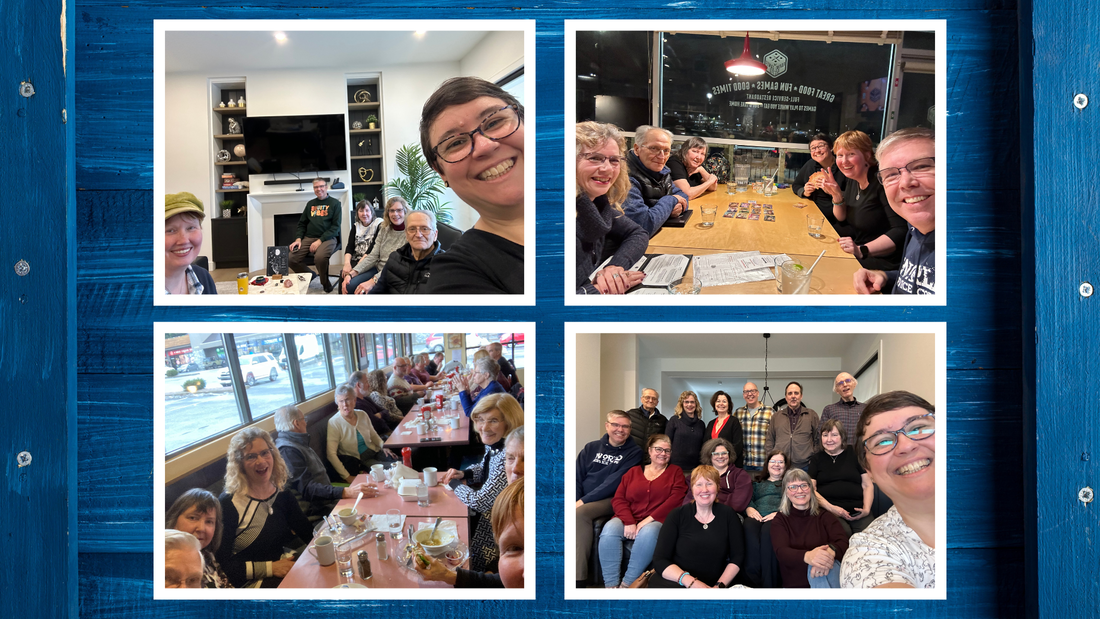
Over the last week, the Leadership Team of Community of Christ in Canada had the opportunity to meet in person to strategize, plan, and get to know one another better. We shared ideas, plans, and the sense of calling we all have for the mission of the church. I am thrilled to be working with this compassionate and hard-working group of people! We also had the opportunity to visit with several congregations and leaders in the Greater Toronto Area and beyond, including the following:
We were also grateful for the participation of Joshua Bennet, Leadership Development Coordinator for Community of Christ in India and Nepal, who joined us as a guest facilitator to share leadership development insights. This was my first trip to Ontario to see Community of Christ in action in this province, and I was heartened by the dedication and commitment of all the various groups we met. These experiences have deepened our sense of community and renewed our enthusiasm for the church’s mission. Thank you for your ongoing support and warm hospitality! |
All Categories
All
Archives
June 2026
|
|
COMMUNITY OF CHRIST
|
SEARCH OUR WEBSITE
EXTERNAL LINKS
|